![]() ![]() ![]() ![]() |
![]() |


| Type: Medium Attack and Level Bomber Origin: North American Aviation (NAA) Models: B-25 to TB-25N, PBJ Series, F-10 Crew: Four To Six First Flight: NA-40 Prototype: January 1939 NA-62 (Production B-25) August 19, 1940 B-25G: August 1942 Service Delivery: N/A Final Delivery: N/A Production: N/A Powerplant: B-25A & B Model: Wright R-2600-9 Double Cyclone Type: 14-cylinder two row radial Number: Two Horsepower: 1,700 B-25C, D & G Model: Wright R-2600-13 Double Cyclone Type: 14-cylinder two row radial Number: Two Horsepower: 1,700 B-25H, J, & F-10 Model: Wright R-2600-29 Double Cyclone Type: 14-cylinder two row radial Number: Two Horsepower: 1,850* *Emergency Rating Dimensions: Wing Span: 67 ft. 7 in. (20.6m) Length: B-25A: 54 ft. 1 in. B-25B, C, & J: 52 ft. 11 in. (16.1m) B-25G & H: 51 ft. (15.54m) Height (Typical): 15 ft. 9 in. (4.80m) Wing Area: N/A Weights: Empty (J, Typical): 21,100 lb. (9580 kg.) Maximum Loaded: B-25A: 27,100 lb. B-25B: 28,640 lb. B-25C: 34,000 lb. (15,422 kg.) B-25G: 35,000 lb. (15,876 kg.) B-25H: 36,047 lb. (16,350 kg.) B-25J (Normal): 35,000 lb. B-25J (Overload): 41,800 lb. (18,960 kg.) |
Performance: Max. Speed: B-25A: 315 mph B-25B: 300 mph B-25C & G: 284 mph (459 km/h) B-25H & J: 275 mph (443 km/h) Initial Climb (A, Typical): 1,500 ft/min (460 m/min) Initial Climb (Late, Typical): 1,500 ft/min (460 m/min) Service Ceiling: B-25A: 27,000 ft (8230 m) Late model, Typical: 24,000 ft (7315 m) Range (All, Typical): 1,500 miles (2414 km) Armament: B-25A: One 0.5 in. Browning M.G. manually aimed in tail Two 0.3 in. Brownings M.G. in waist One 0.3 in. Browning M.G. manually aimed in nose B-25B: Two 0.5 in. Brownings M.G. powered dorsal turret Two 0.5 in. Brownings M.G. in retractable ventral turret Two 0.3 in. Brownings M.G. in waist One 0.3 in. Brownings M.G. manually aimed in nose B-25G: Two 0.5 in. Brownings M.G. powered dorsal turret Two 0.5 in. Brownings M.G. in nose Four 0.5 in. Brownings M.G. on side of nose Two 0.3 in. Brownings M.G. in waist 75mm M-4 Cannon in nose with 21 rounds B-25H: Fourteen 0.5 in. Brownings M.G. 75mm M-4 Cannon in nose with 21 rounds Bomb Load: B-25A 3,000 kb (1361 kg) internally B-25H One 2,000 lb. (907 kg.) Torpedo Or 3,200 lb. (1451 kg.) of bombs internally B-25J 4,000 lb. (1814 kg.) of Bombs internally |
|
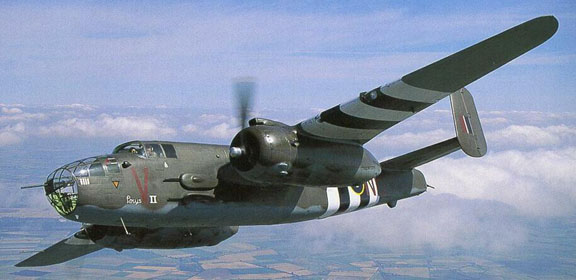
Comments: This aircraft is probably one of
the most famous and recognizable twin-engined bombers ever produced. The
Mitchell flew into the history books on April 18, 1942 when 16 B-25B's led by
Lt. Colonel Jimmy Doolittle launched off the carrier Hornet and made a
symbolic attack against mainland Japan. The B-25 was flown by numerous air forces, including England, China and Russia, and was built in numerous variations. Some variants mounted up to 14 0.5 Browning machine guns or even a 75mm M-4 cannon. These attack variants proved devastating to Japanese shipping and in the ground attack role. Quite a few B-25's survived the post WWII scrapping and served as executive transports, test platforms, and movie camera ships. Today the B-25 has proven to be the most popular and numerous twin-engine warbird. |
| Image 1 - B-25
production line. Image 2 - B-25 production line. Image 3 - B-25 final assembly. Image 4 - Engine being installed. Image 5 - Preparing To Be Painted. Image 6 - Airflow Model. Image 7 - Test firing forward armament. Image 8 - Looking down on a B-25 during mission. |
Image 9 -
Dropping Bombs. Image 10 - Cockpit. Image 11 - Being Refueled. Image 12 - With 75mm Nose gun. Image 13 - Close-up of 75mm gun. Image 14 - Close-Up of 75mm Gun Nose. Image 15 - Close-Up of 75mm Gun Nose with feed doors open. Image 16 - Mitchell III. |