Type: Naval Fighter
Origin: Grumman
Crew: 1
Models: G-36, Martlet, F4F-1 to -4 &
   Eastern Motors FM-1 and FM-2
First Flight:
   XF4F-2: September 2, 1937
   XF4F-3: February 12, 1939
Service Delivery:
   G-36 and F4F-3: March 1943
   FM-2: February 1940
Final Delivery: August 1945
Production: N/A

Powerplant:
XF4F-2:
   Model: Pratt & Whitney R-1830-66 Twin Wasp
   Type: 14-cylinder two-row radial engine
   Number: One       Horsepower: 1,050 hp

G-36 & Martlet I (Wildcat I):
   Model: Pratt & Whitney R-1820-G205A Cyclone
   Type: 9-cylinder radial engine
   Number: One       Horsepower: 1,200 hp

F4F-3:
   Model: Pratt & Whitney R-1830-76
   Type: N/A
   Number: One       Horsepower: 1,200 hp

F4F-4 & FM-1 (Wildcat V):
   Model: Pratt & Whitney R-1830-86
   Type: N/A
   Number: One       Horsepower: N/A

FM-2 (Wildcat VI):
   Model: Pratt & Whitney R-1820-56
   Type: 14-cylinder twin-row radial engine
   Number: One       Horsepower: 1,350 hp

Dimensions:
Wing Span: 11.6m (38 ft.)
Length: 28 ft. 9 in. to 28 ft. 11 in.
Length (FM-2): 8.5m (28 ft. 10 in.)
Height: 3.6m (11 ft. 11 in.)
Wing Area: N/A

Weights:
Empty (F4F-3): 4,425 lb.
Empty (F4F-4): 4,649 lb.
Empty (FM-2): 4,900 lb. (2226 kg.)
Loaded (F4F-3): 5,876 lb.
Loaded (FM-2): 7,412 lb.


Performance:
Max. Speed (F4F-3): 523 km/h (325 mph)
Max. Speed (F4F-4, FM-1): 509 km/h (318 mph)
Max. Speed (FM-2): 534 km/h (332 mph)
Initial Climb (Typical): 2,000 ft/min (610 m/min)
Initial Climb (Early Versions): 3,300 ft/min
Initial Climb (Main Production): 1,920 ft/min
Initial Climb (FM-2): over 2,000 ft/min
Service Ceiling (Typical): 10,670m (35,000 ft.)
Max. Range (Typical): 1448 km (900 miles)

Armament:
XF4F-2:
Two .50 Colt-Brownings in fuselage

F4F-3:
Four .50 Colt-Brownings in outer wings

F4F-4 & Subsequent variants:
Six .50 Colt-Brownings in outer wings

Bomb Load: F4F-4, FM-1 & FM-2
Underwing racks for two 250 lb. (133 kg) bombs.

Avionics:
N/A


Variants:
F4F-7: Reconnaissance version

Comments:
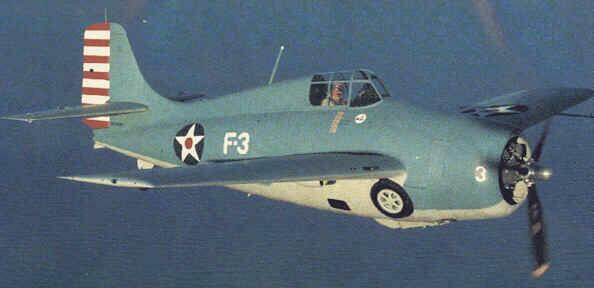
Originally designed as a biplane to replace the successful F3F biplane fighter, the design was altered early in the types development to be a mid-wing monoplane. The prototype lost out to the Brewster Buffalo for a US Navy contract but a revised design incorporating a more powerful engine was ordered by the French Navy in early 1939. The US Navy ordered 54 later that year. After the fall of France, all 100 aircraft were diverted to Britain, where they acquired the name Martlet I. Folding wings were introduced with the F4F-4 and 1,169 aircraft of this type were built for the US Navy plus 220 Martlet IVs for the Fleet Air Arm. Production was also done by the Eastern Aircraft Division of General Motors, delivering 839 FM-1s and 311 Martlet V's. Subsequent variants built for the British assumed the name Wildcat. Eventually Grumman ceased production of the Wildcat except for the F4F-7 and float plane versions, with Eastern taking over production of the final variant, the FM-2, of which 4,777 where delivered.
   Wildcats were involved in thousands of engagements and proved to be particularly suited to operation from escort carriers. Wildcats have been credited with numerous aerial victories as well as several Japanese submarines and even a cruiser.

IMAGE LIBRARY:
Image 1 - Cockpit View - Instrument Panel Image 5 - In flight. Early style markings
Image 2 - In flight. Early style markings Image 6 - VF-11 "Sundowners" flight line. 1943.
Image 3 - Martlet (UK Wildcat) - Warbird Image 7 - A flight of four wildcats
Image 4 - In flight. Early style markings Image 8 - A wildcat on floats


Updated 06-23-01