
U.S.A.A.F. RESOURCE CENTER > EXPERIMENTAL > PREVIOUS PAGE
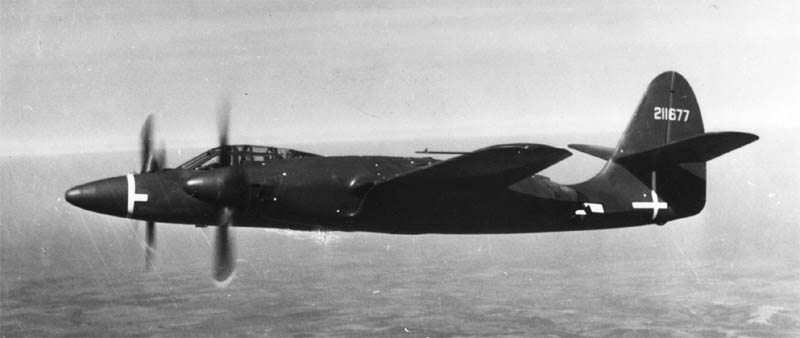
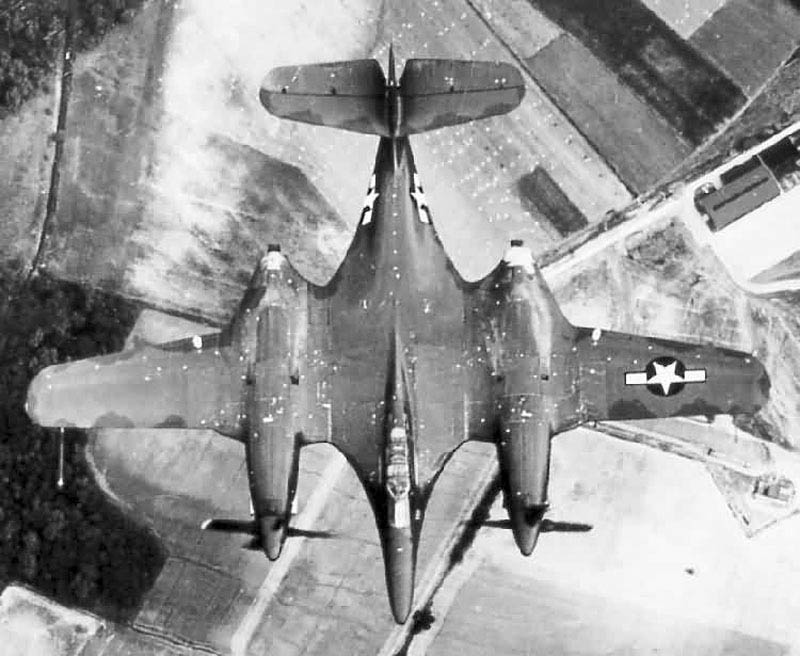
The McDonnell design team created an interesting looking aircraft by using airfoils whenever possible, forming a design that seems to have the various components merge together. The XP-67 was fitted with a pressurized cabin and powered by two Continental XI-1430 engines equipped with GE D-2 Turbo-Superchargers driving four-bladed airscrews. The original armament was to be six .50 machine guns and four 20mm cannon later changed to six 37mm M-4 cannon though studies were made to equip the aircraft with a 75mm cannon.
Ground trials began in early December but halted on the 8th when fires started in both nacelles during an engine run-up. The problem was identified as a malfunction of the exhaust manifold slip rings and delayed the flight trials for nearly a month. Flight testing commenced on January 6, 1944 but the first flight was aborted due to engine problems. Various modification were made and flight testing resumed but was once again halted when on the fourth flight the engines were overspeeded resulting in the bearings burning themselves out.
Due to parts being unavailable the aircraft was returned to McDonnell where modifications to the tailplane were undertaken. It wasn't until March 23, 1944 that flight testing resumed. Despite repeated modifications the aircraft suffered from generally poor performance and dangerous handling characteristics. On September 6th, 1944 the prototype was severely damaged by fire and it was decided that the second prototype would require too much time to complete and the development contract was cancelled.
|
Type: Long Range Fighter Origin: McDonnel Aircraft Corporation Crew: One Model: XP-67 First Flight: January 6, 1944 Production: 1 Prototype Engine: Model: Continental XI-1430-17/19 Type: 12-Cylinder inverted-Vee aircooled Number: Two Horsepower: 1,350 hp Dimensions: Wing span: 55 ft. 0 in. Length: 44 ft. 9.25 in. Height: 15 ft. 9 in. Lifting Surface Area: 414 sq. ft. |
Weights: Empty: 17,745 lb. Loaded: 22,114 lb. Maximum: 25,400 lb.
Performance: Armament: Proposed Six 37mm M4 cannon mounted in wing roots Ammunition: 45 rounds per gun. |


The Complete Encyclodepia of World Aircraft, 1997, Barnes & Nobles Books, ISBN: 0 7607 0592 5
Green, William - War Planes Of The Second World War - Fighters - Vol. 4, 1964, Doubleday And Company, Inc., New York
U.S.A.A.F. RESOURCE CENTER > EXPERIMENTAL > PREVIOUS PAGE