![]() ![]() ![]() ![]() |
![]() |

|
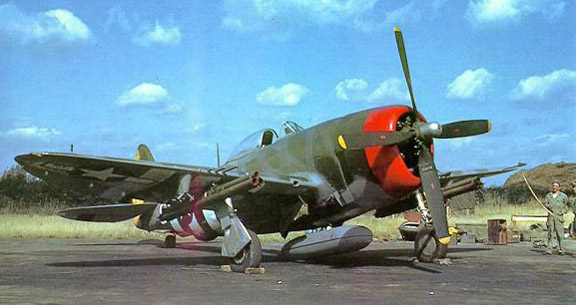
XP-47B: Prototype aircraft Number Built: 1 P-47B: Initial production aircraft with sliding canopy and metal skinned control surfaces. Number Built: 171 P-47C: Revised production version, initial aircraft engined as P-47B. Longer forward fuselage nd provision for belly /bomb racks. Number Built: 602 P-47D: Major production version with R-2800-21W or -59W with water injection. Numerous changes in various production blocks. Number Built: 12,602 XP-47D: 1943 conversion of standard P-47D, equipping it with a pressurized cockpit. Number Built: 1 XP-47F: 1943 conversion of P-47B equipping it with laminar flow wings. Number Built: 1 P-47G: Designation given to a block of early P-47D aircraft built by Curtis-Wright. Number Built: 354 XP-47H: Two P-47Ds rebuilt to accept the Chrysler XIV-2220-1 inverted vee inline engine. Number Built: 2 |
XP-47J: Experimental P-47D with lightened structure and special P&W R-2800-57 (C) with turbocharger. Acheived top speed of 504 mph (811 kph) on August 2, 1944. Number Built: 1 XP-47K: Converted P-47D with teardrop canopy from Hawker Typhoon and a cut down rear fuselage. This modification was later introduced in the P-47D production line. Number Built: 1 XP-47L: Converted P-47D with increased-capacity fuselage fuel tankage. Number Built: 1 YP-47M: Converted P-47D with powerplant of XP-47J. Designed to produce a high-speed "Sprint" aircraft. Number Built: 3 P-47M: Production version of YP-47M. Number Built: 130 XP-47N: Conversion from YP-47M with increased-span strengthened wing containing fuel tanks, strengthened landing gear and other modification to enhance long-range capabilities. Designed for use in Pacifc theater. Number Built: 1 P-47N: Production version of of XP-47N. Later aircraft equipped with R-2800-77 powerplant. Number Built: 1,816 |
|
COMMENTS: The Thunderbolt, designed by Alexander Kartveli, developed a reputation during World War II for extreme toughness and the ability to return it's pilot home even after suffering staggering damage. Nicknamed the "Jug", the Thunderbolt was produced in astonishing number and became the USAAF's premier ground attack fighter-bomber. The type was also used by Brazil, the Free French air force, Mexico, the RAF, and the Soviet Union. An evolutionary development of the P-43 Lancer, the Thunderbolt entered service in June 1942 with the USAAF's 56th Fighter Group being the first unit to recieved the initial P-47B aircraft. This unit was attached to the 8th Air Force by January 1943 and joined by the 78th Fighter group became operational in April 1943. Initial engagements with the Luftwaffe showed severe shortcoming at low and medium altitudes and a insufficient fuel load for the escort mission. Later variants overcame these shortcomings and greatly increased the types capabilities. By war's end the Jug had achieved some remarkable statistics. The Thunderbolt managed to destoy 4.6 aircraft for every one of there own number shot down. While flying of half a million combat sorties, accumulating nearly two million operational hours, the type shot down 3,752 enemy aircraft as well as destroying 3,315 aircraft on the ground. It is little wonder that the type achieved such a legendary and highly respected status. The Jug remained in service with the Air National guard units until 1954 and in numerous air forces around the world for many years after. |