
U.S.A.A.F. RESOURCE CENTER > BOMBERS > PREVIOUS PAGE
|
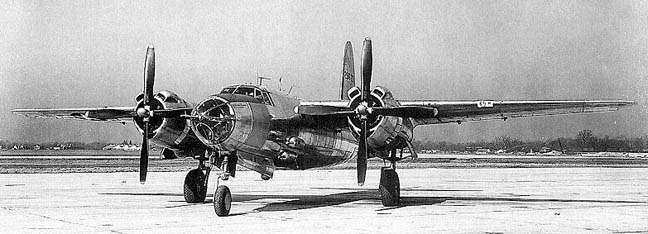
Type: Medium Bomber Origin: Martin Models: Model 179 B-26A to G Marauder I to III |
Crew: Five To Seven First Flight: November 25, 1940 Service Delivery: February 25, 1941 Final Delivery: March 1945 Production: 5,157+ |
|
Powerplant: B-26 Model: Pratt & Whitney R-2800-5 Double Wasp Type: 18-cylinder two row radial Number: Two Horsepower: 1,850 B-26A Model: Pratt & Whitney R-2800-39 Double Wasp Type: 18-cylinder two row radial Number: Two Horsepower: 2,000 B-26B through G Model: Pratt & Whitney R-2800-43 Double Wasp Type: 18-cylinder two row radial Number: Two Horsepower: 2,000 Dimensions: Wing Span: B-26A & first 641 B-26B: 65 ft. (19.8m) Remainder: 71 ft. (21.64m) Length: B-26: 56 ft. B-26A & B: 58 ft. 6 in. B-26F & G: 56 ft. 6 in. Height: Up to B-26E: 19 ft. 10 in. (6.04m) Remainder: 21 ft. 6 in. (6.55m) Wing Area: N/A Weights: Empty: Early, Typical: 23,000 lb. (10,433 kg.) B-26F & G: 25,300 lb. (11,490 kg.) Maximum Loaded: B-26: 32,000 lb. B-26A: 33,022 lb. First 641 B-26B: 34,000 lb. Remaining B-26B: 37,000 lb. (16,783 lb.) B-26F: 38,000 lb. B-26G: 38,200 lb. (17,340 kg.) |
Performance: Max. Speed: Up To B-26E, Typical: 310 mph (500 km/h) B-26F & G: 280 mph (451 km/h) Initial Climb (Typical): 1,000 ft./min. (305 m/min.) Service Ceiling: Up To B-26E, Typical: 23,000 ft. (7000 m) B-26F & G: 19,800 ft. (6040 m) Range (All, with 3,000 lb. bombload): 1,150 miles (1850 km) Armament: B-26 & B-26A: Either .30 or .50 Browning M.G. One or Two machine guns manually aimed in tail Two machine guns in powered dorsal turret One machine gun manually aimed in tail B-26B to E: 1 x .50 Browning M.G. manually aimed in nose 2 x .50 Browning M.G. in powered dorsal turret 2 x .50 Browning M.G. in waist 1 x .50 Browning M.G. "tunnel gun" 2 x .50 Browning M.G. in powered tail turret 4 x .50 Browning M.G. fixed on sides of forward fuselage B-26F & G: 1 x .50 Browning M.G. manually aimed in nose 2 x .50 Browning M.G. in powered dorsal turret 2 x .50 Browning M.G. in waist 2 x .50 Browning M.G. in powered tail turret 4 x .50 Browning M.G. fixed on sides of forward fuselage Bomb Load: Internal load of 5,200 lb. (2359 kg) up to 641st B-26B, after which rear bay was disused (eliminated in F, G) to give maximum load of 4,000 lb. (1814 kg.). Early versions could carry two torpedoes. |
When this bomber first entered service it quickly became known as the "Widow-Maker" due to the high numbers of crashes relative to other types. This was not caused by a design flaw but a design philosophy. When Martin created the design for the 1939 medium bomber competition for the U.S. Army it pulled out all the stops. Chosing a wing design that optimized cruise efficiency that unfortunately sacrificed low-speed handling. When pilots transitioned to the type training was insufficient in regards to this characteristic and thus less experienced pilots suffered. Additional training rectified this problem and by VE-day the B-26 had achieved the lowest loss rate of any U.S. Bomber in the ETO.
The Marauder was deployed to the South Pacific the day after Pearl Harbor and was used extensively throughout the theatre. Often the rear bomb bay was filled with an auxillery fuel tank.
The Marauder was withdrawn from service and the B-26 designation was transferred to the A-26 Invader.
 |
 |
 |
 |
 |
 |
 |
 |
Sources:
Gunston, Bill - The Encyclodepia of the Worlds Combat aircraft, 1976, Chartwell Books, Inc., New York
U.S.A.A.F. RESOURCE CENTER > BOMBERS > PREVIOUS PAGE