back to Fighter Specifications Directory


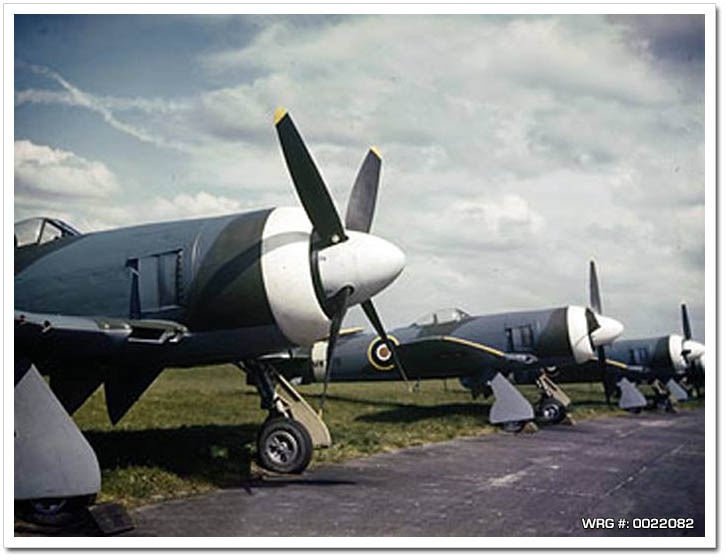
Prototype Tempest Mark V (HM595) with bubble canopy.

Type: Single Seat Fighter Bomber
Origin: Hawker
Models: Mark II, V, and VI
First Flight
   Prototype Mk. V: September 2, 1942
   Prototype Mk. I: February 24, 1943
   Production Mk. V: June 21, 1943
   Prototype Mk. II: June 28, 1943
   Production Mk. II: October 4, 1944
   Prototype Mk. VI: May 9, 1944
Number Produced:
   Mark II: 472 (50 built by Bristol & Gloster)
   Mark V: 800
   Mark VI: 142

Engine:
Mark II
  Model: Bristol Centaurus 5 or 6
  Type: 18 Cylinder Sleeve-valve two-row radial
  Number: One    Horsepower: 2,596 hp

Mark V
  Model: Napier Sabre II
  Type: 24 Cylinder Flat-H Sleeve-valve liquid cooled
  Number: One    Horsepower: 2,180 hp

Mark VI
  Model: Napier Sabre V
  Type: 24 Cylinder Flat-H Sleeve-valve liquid cooled
  Number: One    Horsepower: 2,340 hp

Dimensions:
Wing span (All): 41 ft. (12.5m)
Length:
    Mk. II: 34 ft. 5 in. (10.5m)
    Mk. V & VI: 33 ft. 8 in. (10.26m)
Height:
    Mk. II: 15 ft. 10 in. (4.8m)
    Mk. V & VI: 16 ft. 1 in. (4.9m)
Wing Surface Area:
    Mk. II: 303.7 ft²
    Mk. V & VI: 302 ft²

Weights:
Empty:
    Mk. II: 8,900 lb. (4037 kg)
    Mk. V & VI: 9,100 lb. (4128 kg)
Loaded:
    Mk. II: 11,800 lb.
    Mk. V: 11,400 lb.
Maximum:
    Mk. II: 13,250 lb. (6010 kg)
    Mk. V & VI: 13,500 lb. (6130 kg)
  Performance:
Maximum Speed:
    Mk. II: 440 mph (708 km/h)
    Mk. V: 427 mph (688 km/h)
    Mk. VI: 438 mph (704 km/h)
Initial Climb:
    Mk. II: 3,600 ft/min (1097 m/min)
    Mk. V & VI: 3,000 ft/min (914 m/min)
Service Ceiling (All): 37,000 ft. (11,280m)
Range: (with Bombs, no tanks)
    Mk. II: 820 miles (1319 km)
    Mk. V & VI: 740 miles (1191 km)

Armament: All
Four 20mm Hispano Cannon in outer wings
    Ammunition: 150 rpg.

Payload:
Underwing racks for Eight rockets or up to 2,000 lb. (907 kg) bombs.

Click to enlarge
Prototype Tempest Mark V (HM595) with original canopy.

Image 1 Mark V 3-view illustration.
Image 2 Mark V (NV768) with annular radiator.
Image 3 Mark V (SN354) with 40mm cannon.
Image 4 Mark VI (NV778).

Click to enlarge
Production Mark II (PR806).

Image 5 Mark II 3-view illustration.
Image 6 Mark II prototype (LA602).

Click to enlarge
Sole prototype Mark I (HM599).

Image 7 Mark I 3-view illustration.
Image 8 Sole prototype Mark I (HM599).

Comments:
   In an effort to correct problems with compressibility encountered with the wing design of the Hawker Typhoon, extensive changes were made in the design. These included a new wing cross section that became much thinner and spitfire like. The engine was also changed and the cannon were buried within the wing. This radically altered design was used as the template for the Typhoon II specification but it was eventually decided that the design was so different that a new designation was warranted. In this manner the Tempest was born.
   The Tempest proved to be quite adept at downing V-1 flying bombs, accounting for over 1/3 of those shot down in 1944. Eventually the Mark II (developed after Mk. V & VI) entered service in November 1945 with production being handled by Gloster, then Bristol before reverting back to Hawker.
   The Mark II was redesignated the F.2 and served until 1953. 89 of these were then passed on to India and an additional 24 new airframes were manufactured for Pakistan. A few Mk V & VI (redesignatedpost-war as F.5 and F.6) continued to serve after wars end as target tugs.

Sources:
Gunston, Bill - The Encyclodepia of the Worlds Combat aircraft, 1976, Chartwell Books, Inc., New York
Green, William - War Planes Of The Second World War - Fighters - Vol. 2, 1961, Hanover House, New York